
Table of Contents
- Start With a Floor Plan Before You Buy Anything
- Small Living Room Layout Ideas That Actually Work
- How to Arrange Furniture in a Small Living Room
- Space-Saving Furniture for Apartments: What to Look For
- Vertical Storage, Mirrors, and Lighting That Open Up the Room
- Renter-Friendly and Budget DIY Touches That Add Personality
- Common Mistakes That Make a Small Living Room Feel Smaller
- Conclusion
- Frequently Asked Questions
Last Updated: September 11, 2026
Start With a Floor Plan Before You Buy Anything
Most small apartment living room styling fails before a single piece of furniture arrives: people buy for the room they wish they had, not the room they actually have. A floor plan fixes that.
A floor plan is a scaled drawing of your room that shows walls, doors, windows, and the footprint of every piece of furniture you're considering. It takes twenty minutes to make and saves you from expensive returns.
Measure the Room and Mark Traffic Flow
Start with a tape measure and a notebook. Record the length and width of every wall, the position of doors and windows, and the height of your windowsills, then sketch the room on graph paper at one square equals one foot.
Next, mark your traffic flow. Walk the room the way you actually move, entry to kitchen, sofa to bathroom, front door to closet, and draw those paths in pencil. Any placement that blocks a path will annoy you within a week.
According to apartment living space data from the U.S. Census Bureau, rental units in many metro areas are shrinking, which makes precise measurement more important than ever. A floor plan turns guesswork into a checklist.
Small Living Room Layout Ideas That Actually Work
The best small living room layout ideas treat the room as zones, not a single open box. Layout determines how large a room feels more than square footage does.
Four layouts work in most apartments:
- The L-shape: Sofa against one wall, loveseat or accent chairs perpendicular. Leaves a clear walkway and works well in narrow rooms.
- The conversation circle: Seating arranged around a central area rug. Best for square rooms and renters who entertain.
- The wall-hugger: Everything pushed to the perimeter. Works only if you have an open-concept space and can define zones with a rug.
- The floating sofa: Sofa placed away from the wall to create a walkway behind it. Ideal when your entry door opens directly into the living area.
The 2/3 Rule and Other Proportion Guidelines
The 2/3 rule states that your main furniture piece should take up roughly two-thirds of the wall it sits against. A sofa spanning the entire wall feels cramped; one covering a third looks unfinished.
Apply the same logic to your area rug: it should be large enough that at least the front legs of every seating piece rest on it.
How to Arrange Furniture in a Small Living Room
Learning how to arrange furniture in a small living room comes down to three moves: anchor the seating, define the zone, and keep the paths clear.
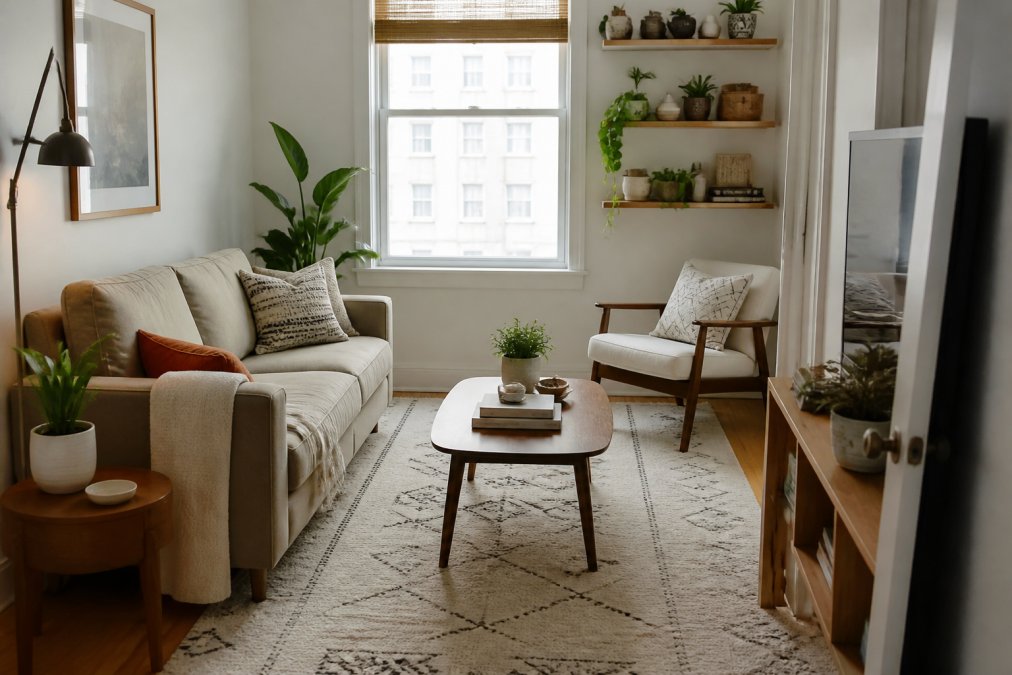
Start with your largest piece, usually the sofa or loveseat. Place it against the longest uninterrupted wall, facing the room's focal point, a window, fireplace, or television. Then add secondary seating at an angle, not parallel; angled accent chairs break up the boxy feel of a small room.
Leave at least 18 inches between the coffee table and the sofa, or you'll be sidestepping every time you sit down.
Zoning Without Walls
Room zoning divides one open space into functional areas using furniture and rugs rather than walls. In a studio or open-concept apartment, it separates the living area from the sleeping area or home office.
Use these tools to zone:
- An area rug to define the living zone
- A console table behind the sofa as a soft divider
- A bookshelf placed perpendicular to the wall
- A change in lighting between zones
Space-Saving Furniture for Apartments: What to Look For
Space-saving furniture for apartments earns its place by doing two jobs at once. Check for these qualities:
- Multifunctional design: An ottoman with hidden storage, a console table that folds out to a desk, a sofa bed that doesn't feel like a sofa bed.
- Wall-mounted options: Floating shelves and wall-mounted desks free up floor space entirely.
- Scaled-down proportions: A loveseat at 60 inches fits where a 90-inch sofa won't, and it looks intentional rather than cramped.
- Visual weight: Choose pieces with exposed legs and lighter fabrics. Heavy, skirted furniture reads as bulky even when the footprint is small.
Vertical Storage, Mirrors, and Lighting That Open Up the Room
Vertical storage, mirrored surfaces, and layered lighting do more for a small room than any single furniture purchase. They use what you already have, walls, ceiling plane, and light, instead of asking for more floor. Treat them as one system, not three shopping lists.
Vertical Storage That Earns Its Wall Space
Vertical storage means going up instead of out. A tall bookcase with deep shelves eats floor depth and casts a heavy shadow; a shallow wall-mounted system holds nearly as much and visually recedes.
A few rules of thumb that hold up in practice:
- Keep depth under 12 inches for wall-mounted shelving over seating. Deeper shelves crowd the head and read as bulk.
- Anchor to studs, not drywall anchors, for anything over 20 pounds. A loaded shelf is a falling hazard, and renters who patch a failed anchor hole lose their deposit faster than they lose the shelf.
- Run shelves to the ceiling where you can. A unit that stops two feet short of the ceiling leaves a dead band that makes the wall look shorter, not taller.
- Use the door swing zone. The wall behind a door that opens inward is often the single most underused vertical surface in a small apartment. A slim over-the-door rack or a shallow shelf there costs zero usable floor.
For renters who can't drill, tension-pole shelving and freestanding ladder shelves are the two workhorses. Tension poles work best in a corner between two walls; ladder shelves need a wall to lean against and a floor that's reasonably level.
Mirrors: Placement Beats Size
Mirrors expand perceived space by reflecting light and sightlines, but placement matters more than dimensions. A large mirror aimed at a blank wall just reflects a blank wall.
- Opposite the main window doubles natural light and gives the room a second light source.
- Perpendicular to the window (on a side wall) bounces light across the room instead of back at the glass.
- Behind a lamp or console creates a layered glow that reads as depth.
- Leaning a full-length mirror against a wall is the renter-friendly move, no hardware, no holes, and you can reposition it as the seasons shift the light.
One caution: a mirror facing a cluttered surface doubles the clutter. Point it at something you actually want to see twice.
Lighting Layers That Actually Work
A single overhead fixture flattens a room. The fix is three layers, each doing a different job:
- Ambient, a ceiling fixture or a floor lamp in a corner, aimed at the ceiling to bounce light down softly.
- Task, a table lamp beside your seating, ideally with a shade that diffuses rather than spotlights.
- Accent, a small lamp on a console or shelf, or a plug-in wall sconce, to add a pool of warm light at eye level.
Warm bulbs in the 2700K to 3000K range keep the space cozy; cooler bulbs (4000K and up) read as office lighting and make small rooms feel institutional. Put ambient and task lights on separate switches or smart plugs so you can dim the room in stages as evening comes on.
The Overlooked Layer: Sound
Most small-space guides stop at sight. But a small living room with hard floors, bare walls, and a single window often sounds as cramped as it looks, every footstep and conversation bounces off the same surfaces.
Styling for sound is styling for comfort. A few low-cost moves:
- A high-pile or wool area rug absorbs footfall and conversation echo far better than a flat-weave or jute rug.
- Floor-to-ceiling curtains (even over blinds) soften the wall behind them and cut reflected sound.
- An upholstered headboard or a fabric-covered acoustic panel behind the sofa does double duty as a design feature and a sound absorber.
- Bookshelves with books on them are one of the best passive absorbers you can own, irregular surfaces break up sound waves.
The U.S. Department of Energy's guidance on lighting and window treatments notes that how you manage natural light affects both how a room feels and how much energy you use. The same logic applies to sound: the soft goods that manage light also manage noise, so choose them with both in mind.
Renter-Friendly and Budget DIY Touches That Add Personality
Renter-friendly design means nothing that requires drilling into a wall you don't own, and nothing you can't undo in an afternoon. Most "renter hacks" fail for predictable reasons, adhesive that pulls paint, fabric that traps odor, or a layout that fights how you actually live. Here's how to pick the ones that survive a lease.
The DIY Moves That Actually Hold Up
- Peel-and-stick wallpaper on one accent wall. Works best on smooth, painted drywall. Skip it on textured walls, fresh paint (wait 30 days), or anywhere near a shower, humidity loosens the adhesive. Test a corner square for a week before committing to a full wall.
- Removable adhesive hooks for lightweight art. Follow the weight rating literally. A 5-pound hook holding a 6-pound frame will fail, usually at 2 a.m. Clean the wall with rubbing alcohol first; dust is the number-one cause of early failure.
- A tension rod to hang curtains without hardware. Best inside a window frame or between two walls. It will not hold heavy blackout drapes, use it for sheers or lightweight cotton, and check the rod's weight limit.
- Slipcovers to refresh a sofa you already own. Measure the sofa's back height and seat depth before ordering; a slipcover that's too small will not stay tucked. Washable cotton or a cotton-blend holds up better than stretch polyester, which pills.
- A neutral palette with one bold accent color, carried through a throw, a cushion, and a small piece of art. This is the single cheapest way to make a room look intentional rather than assembled.
A neutral palette does more for a small room than a busy one. Light walls, a warm white ceiling, and a single accent color create openness without feeling sterile.
The Pet-Friendly Layer Most Guides Skip
If you share a small living room with a dog or cat, the room has to work for both of you, and most styling advice ignores that. A few adjustments keep the space looking intentional rather than overtaken:
- Choose a low-pile or flat-weave rug if you have a shedder. High-pile traps hair and is hard to vacuum in a small room. A washable cotton rug you can toss in the machine is the renter's best friend.
- Pick performance fabrics for the sofa and chairs, solution-dyed acrylic, tight-weave cotton, or leather. They wipe clean and resist odor in a way that linen and velvet do not.
- Give the pet a designated spot rather than letting beds and toys drift. A single basket by the sofa, a covered pet bed that doubles as an ottoman, or a slim console with a cubby keeps the room reading as designed.
- Skip tasseled or fringed throws if you have a chewer. They unravel fast and become a hazard.
- Lift the food and water bowls onto a low tray or a raised feeder. It keeps spills contained and stops the bowl from migrating across the floor.
The Psychological Angle: Layout Affects How You Feel
Almost no small-space guide addresses this: how you arrange a room changes how you feel in it, not just how it looks. In a confined space, that effect is amplified.
A few patterns worth knowing:
- Seating that faces a wall (rather than a window, a focal point, or another person) tends to feel like a waiting room. Angle at least one chair toward the room, not the wall.
- A clear sightline from the entry to the far side of the room makes the space feel larger and calmer. Blocking that line with a tall piece creates a sense of pressure the moment you walk in.
- A defined "landing zone" near the door, a hook, a tray, a small bench, reduces the low-grade stress of arriving home to a cluttered room.
- Warm light at eye level in the evening signals rest; overhead light signals activity. Matching the light to the time of day is one of the cheapest mood upgrades you can make.
Arranging for sightlines and light first, decor second, can lead to a more satisfying result than starting with a color scheme.
The U.S. Department of Energy's guidance on lighting and window treatments notes that how you manage natural light affects both how a room feels and how much energy you use. Layering curtains over blinds gives you control over both, and if you're renting, tension rods and removable brackets let you get there without touching the wall.
Common Mistakes That Make a Small Living Room Feel Smaller
Five mistakes account for most small rooms that feel cramped:
| Mistake | Why It Backfires | The Fix |
|---|---|---|
| Oversized furniture | Blocks traffic flow and eats floor space | Measure first, choose scaled-down pieces |
| Too-small area rug | Visually chops the room into fragments | Size up so front legs rest on the rug |
| Dark walls throughout | Absorbs light and shrinks perceived space | Keep walls light, add one accent wall |
| Clutter on every surface | Adds visual weight with no function | Declutter, then use hidden storage |
| Single overhead light | Flattens the room and highlights its limits | Add task and accent lighting layers |
Two more mistakes worth naming: pushing every piece of furniture against the walls creates a dead zone in the middle that reads as empty rather than open, and skipping acoustic management leaves a small room echoey and unsettled, undermining the cozy effect you're after.
Conclusion
Styling a small apartment living room is a discipline of measurement, proportion, and restraint. Every piece you bring in should earn its footprint.
At Nae's Specialty, we handpick home essentials and pet supplies with exactly that in mind. Our curated selection focuses on quality, utility, and beauty, so you can find pieces that work in a small space without hunting through a dozen stores. Whether you need a space-saving accent or a cozy spot for your pet, our collection is built for a well-lived, comfortable home.
Get started with Nae's Specialty and find the pieces that make your small living room feel like the one you actually want to live in.
Frequently Asked Questions
What is the 2/3 rule for living rooms?
The 2/3 rule says your main furniture piece, usually the sofa, should take up about two-thirds of the wall it sits against. This keeps proportions balanced so the room feels full without being cramped. If your sofa is longer than two-thirds of the wall, it can swallow the space. If it is much shorter, the room looks unfinished. Pair it with a scaled-down coffee table and one or two accent chairs to complete the arrangement without blocking walkways.
What are some common small living room mistakes?
The biggest mistake is pushing all furniture against the walls, which creates dead space in the middle and makes conversation awkward. Other common errors include choosing oversized furniture, skipping an area rug that defines the seating zone, and relying on one overhead light instead of layered lighting. Runners-up: too many small decor pieces that add visual clutter and heavy dark curtains that block natural light. Fixing even two of these can make a small apartment living room feel noticeably larger.
How do you make a small apartment living room look bigger?
Use a neutral palette on walls and large furniture, then add depth with mirrored surfaces and sheer curtains that let in natural light. Choose a loveseat or sofa with exposed legs so you can see more floor, which tricks the eye into reading the room as larger. Wall-mounted shelving and vertical storage draw the gaze upward. An area rug that fits the seating zone, not one that is too small, also helps the room feel intentional rather than cramped.
How can I add personality to a rental living room without painting?
Peel-and-stick wallpaper, removable wall decals, and gallery walls hung with damage-free strips let you add color and texture without touching the paint. Swap out cabinet hardware or add a console table with a lamp and a few books. Textiles are your best friend: a patterned area rug, throw pillows, and a cozy blanket bring warmth and character. Layer in a floor plant or a small shelf of curated objects. These renter-friendly touches are easy to change when you move.